
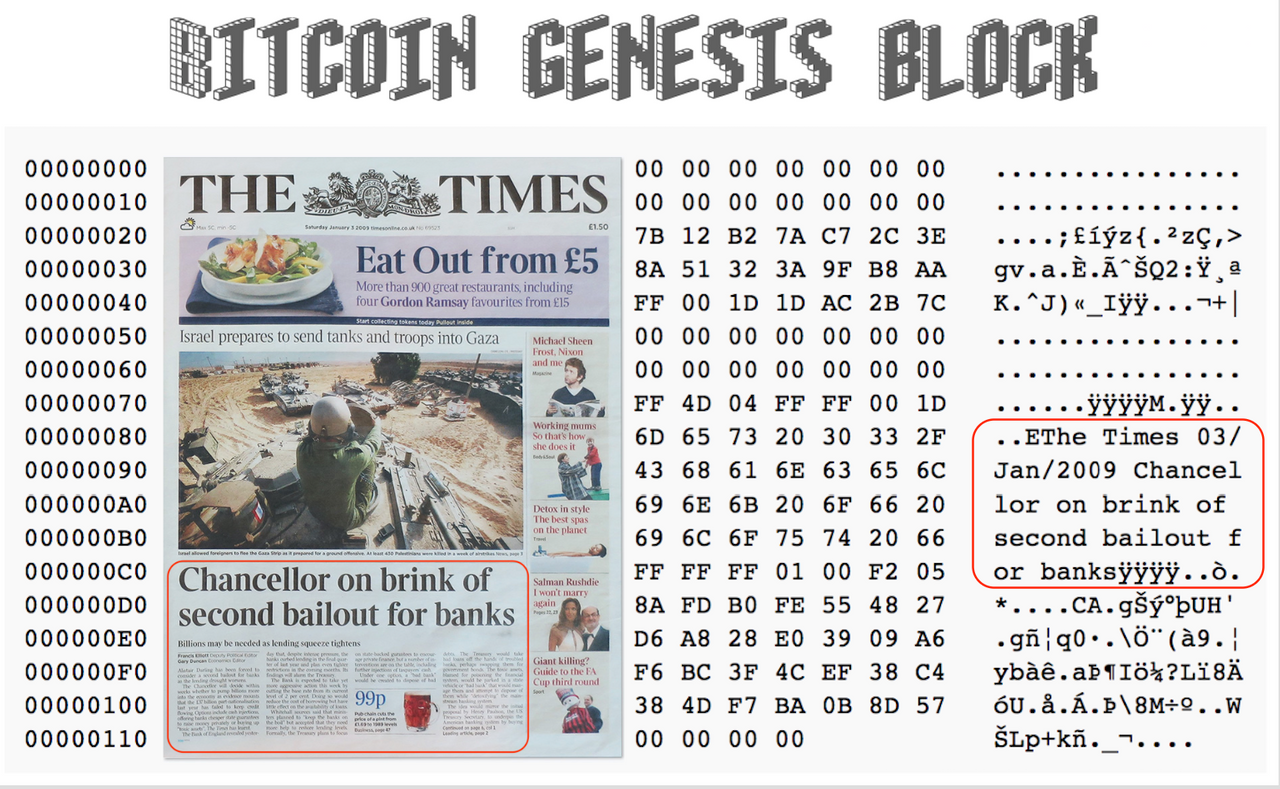
In our previous post, we explored the background of Bitcoin’s birth and the visionaries who inspired Satoshi Nakamoto. Today, we look at the actual beginning of the Bitcoin network: the Genesis Block. We will uncover the symbolic message hidden within it and the key figures who took the first steps alongside Bitcoin.
1. The Genesis Block: The Ancestor of All Blocks
On January 3, 2009, the historic first block of Bitcoin, known as Block 0, was created. We call this the Genesis Block. Unlike regular blocks, the Genesis Block does not have a previous block hash to reference; it is the independent starting point of the entire chain.
An interesting fact is that the first 50 Bitcoins issued through the Genesis Block are hardcoded to be unspendable. This is often interpreted as Satoshi’s intention to make the Genesis Block a permanent, immovable foundation of trust rather than just a source of funds.
2. A Message Carved in Code: The Second Bailout
Satoshi Nakamoto embedded a short but powerful sentence within the coinbase transaction of the Genesis Block:
The Times 03/Jan/2009 Chancellor on brink of second bailout for banks
This was the front-page headline of The Times, a British daily newspaper, on January 3, 2009. Why did Satoshi choose this specific phrase? It carries two significant meanings.
First, it serves as a timestamp. It proves beyond a doubt that the block was created on or after January 3, 2009.
Second, it is a manifesto. At the time, the world was reeling from a financial crisis caused by reckless money printing and a failing banking system. By quoting this headline, Satoshi was critiquing the failures of centralized finance and declaring the need for a decentralized currency that no single entity could manipulate or bail out.
3. The First Evangelist: Hal Finney
When Bitcoin was first released, most people dismissed it as spam or a toy for geeks. However, there was one person who immediately recognized its value: the legendary cryptographer Hal Finney.
Hal Finney was the first person to download and run the Bitcoin software after Satoshi released it. On January 11, 2009, he posted the historic tweet: Running bitcoin.
Even more significant was the event on January 12, 2009. Satoshi sent 10 BTC to Hal Finney as a test. This was the first-ever P2P transaction in Bitcoin history. Hal Finney worked closely with Satoshi through numerous emails to fix early bugs and improve the system.
Even while battling ALS (Lou Gehrig’s disease), he never doubted the future of Bitcoin. Before he passed, he even made a mathematical prediction that a single Bitcoin could one day be worth millions of dollars.
4. The Heroes Who Sustained the Early Days
Beyond Hal Finney, many others laid the bricks for Bitcoin’s foundation. These include Wei Dai, who proposed b-money, and Gavin Andresen, who took over the leadership of Bitcoin Core development after Satoshi vanished.
Nick Szabo is also a notable figure; he designed Bit Gold, a system so similar to Bitcoin that many suspected him of being Satoshi Nakamoto himself. It was the collective intelligence of these pioneers that allowed Bitcoin to keep running even after its creator stepped away from the spotlight.
Closing Thoughts: The Message is Still Valid
More than 15 years after Bitcoin’s birth, the message in the Genesis Block still asks us a vital question: Is the financial system we trust truly safe? And who is really protecting your assets?
At TradingRM, we believe that understanding why Bitcoin was created is the key to a successful investment. When you understand the origin, you can build a solid investment philosophy that remains unshaken by market volatility.
In our next post, we will cover the famous Pizza Day—the moment Bitcoin first received a market price—and the formation of the early crypto market.