
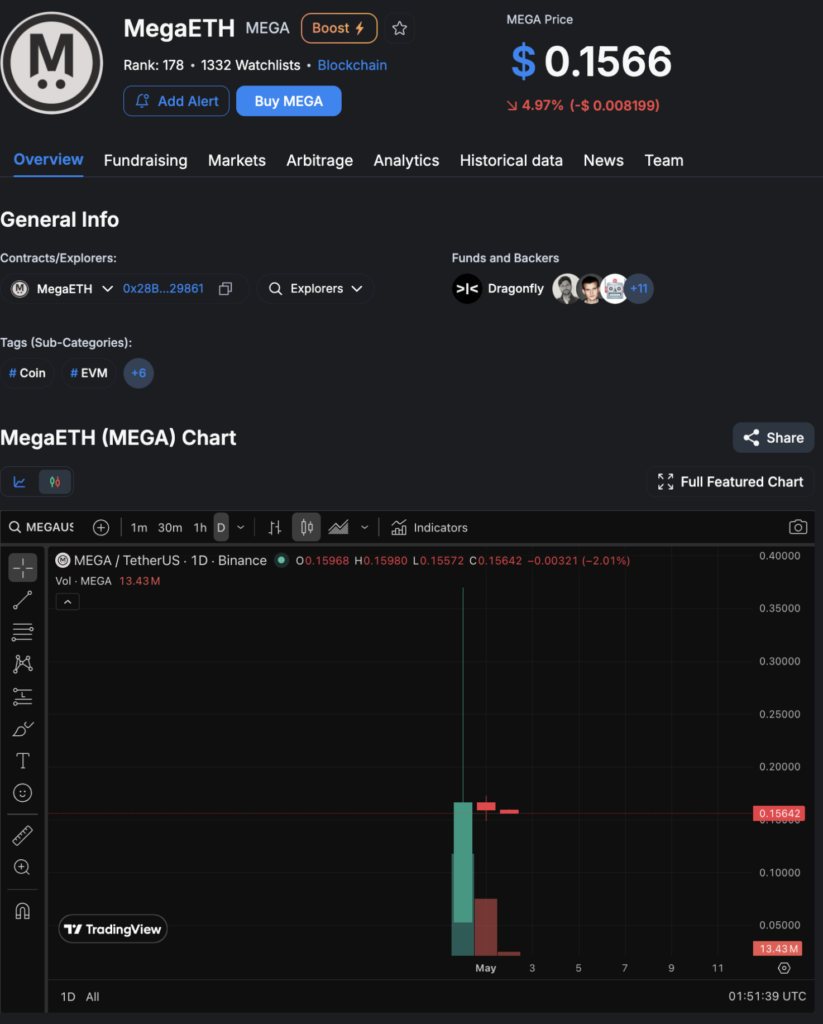
On April 30, 2026, MegaETH officially transitioned from a highly anticipated scaling project to a live asset with the launch of the MEGA token. Debuting on major tier-1 exchanges including Binance, OKX, and Coinbase, MegaETH is not just another Layer 2—it is a bold attempt to redefine the Ethereum experience as a “real-time” operating system.
1. The Narrative: “Real-Time Ethereum”
While most Layer 2 solutions compete on gas fees or airdrop incentives, MegaETH has staked its reputation on speed. The project markets itself as the “Real-time Ethereum,” aiming to bring Web2-level responsiveness to decentralized applications.
Technically, this is achieved through the MegaEVM—a custom execution environment that introduces a hybrid block structure:
- Mini-blocks: Generated every 10ms, enabling near-instant transaction feedback.
- Standard EVM blocks: Generated every 1초, ensuring 100% compatibility with existing Ethereum wallets, explorers, and developer tools.
This architecture is specifically designed for high-frequency trading (HFT), real-time on-chain gaming, and the burgeoning AI Agent economy, where sub-second latency is a prerequisite for adoption.
2. Strategic Backing: The Vitalik “Signal”
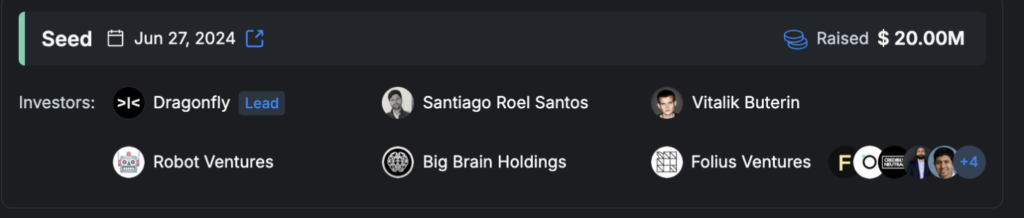
MegaETH’s initial momentum is heavily rooted in its elite backing. The project raised significant capital from Dragonfly, with direct participation from Ethereum co-founder Vitalik Buterin, Joseph Lubin, and prominent figures like Cobie.
Vitalik’s involvement is particularly noteworthy. His public support and personal investment signal that MegaETH is not merely a “copy-paste” L2, but a technical peer that aligns with Ethereum’s long-term roadmap for high-performance execution.
3. KPI-Based Tokenomics: A Shift in Incentives
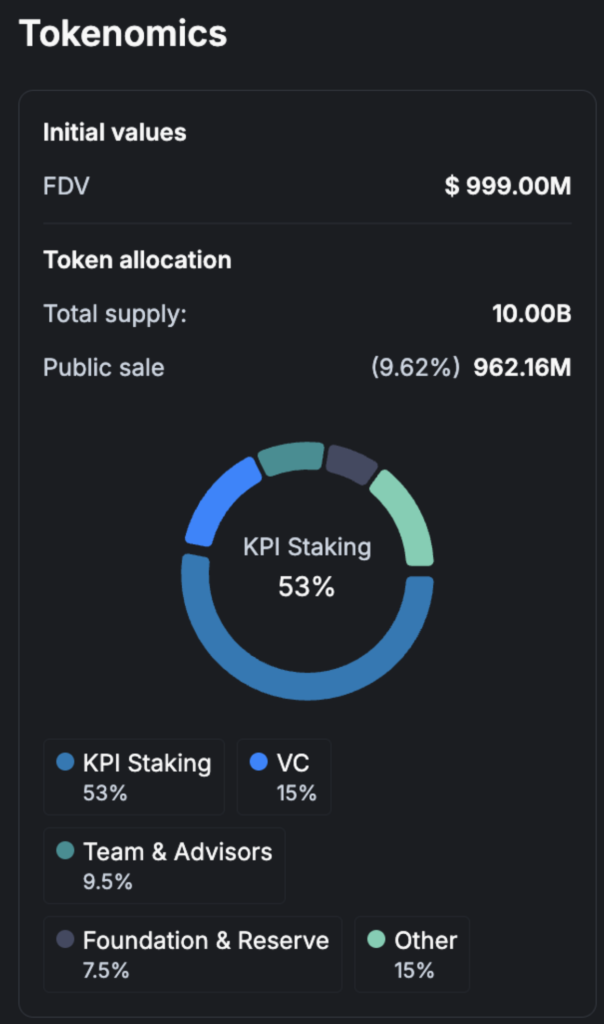
MEGA’s tokenomics represent a significant departure from traditional “time-based” vesting. Out of the total supply of 10 billion MEGA, a staggering 53.3% is allocated to KPI-based rewards.
Instead of tokens unlocking on a fixed calendar date—which often creates artificial sell pressure—MEGA unlocks are tied to network milestones:
- Ecosystem Growth: Token emissions are gated by the launch of active applications (the “Mega Mafia” apps).
- Stablecoin Adoption: The circulation of USDm, MegaETH’s native stablecoin, acts as a primary trigger for incentive distributions.
This structure aligns the interests of VCs and the team with the actual health of the network, ensuring that “value” must be created before “liquidity” is released.
4. Market Performance & Valuation (As of May 2, 2026)
Following its multi-exchange listing, MEGA saw a volatile price discovery phase. After an initial peak near $0.22, the token has stabilized around $0.15 – $0.17 in the first 48 hours.
- Current Market Cap: ~$180 million
- Fully Diluted Valuation (FDV): ~$1.6 billion
- Circulating Supply: ~1.13 billion MEGA
The $1.6B FDV reflects high market expectations. However, with over 50% of the supply gated behind performance metrics, the “effective” inflation is much more controlled compared to peer L2s with massive, time-locked cliffs.
5. Ecosystem Dynamics: The USDm Loop
A critical component of MegaETH’s value capture is USDm, its native stablecoin integrated with Ethena. The MegaETH Foundation has committed to using revenue generated from USDm activity to buy back MEGA tokens on the open market. This creates a reflexive loop where increased DeFi activity on the chain directly supports token demand—a feature many other L2 tokens currently lack.
6. Risk Factors to Monitor
Despite the strong start, MegaETH faces several hurdles:
- Centralization: Like many early-stage L2s, MegaETH currently relies on a single active sequencer for performance. Achieving true decentralization while maintaining 10ms latency is the project’s biggest technical challenge.
- Execution Risk: The KPI-based unlock model is innovative, but if the ecosystem fails to attract “sticky” applications, the network may struggle to trigger the rewards needed for long-term security and staking.
Conclusion: Trading is a Routine, Not a Mood
MegaETH has successfully transitioned from a technical vision to a market reality. It stands as one of the most promising “Real-time” infrastructures for the 2026 bull cycle. However, as we always emphasize at TradingRoom, don’t trade on the hype.
Monitor the TVL (currently around $200M) and the growth of the Mega Mafia applications. If MegaETH can prove that its 10ms speed actually drives new types of on-chain behavior, the $1.6B FDV may eventually look like a discount.